One of the oldest
Indian-planted tea estates
in West Bengal
In the Terai foothills of West Bengal, Kamalpur stands quietly — a rare Indian-owned estate with origins tracing back to the 1850s.
Spread across 201 acres, Kamalpur exists at the edge of the forest — a living landscape where wildlife thrives, and the guiding philosophy is observation without interference.
Known as the smallest tea estate in North India, Kamalpur holds a rare distinction: high yield without excess scale.
For over three generations, the same family has continued its stewardship, shaping the land with consistency, restraint, and long-term intent.

In the Terai foothills of West Bengal, Kamalpur Tea Estate stands quietly as a rare Indian-owned estate with origins tracing back to the 1850s.
Spread across 201 acres, Kamalpur Tea Estate exists at the edge of the forest — a living landscape where wildlife thrives, and the guiding philosophy is observation without interference.
Known as the smallest tea estate in North India, Kamalpur holds a rare distinction: high yield without excess scale.
For over three generations, the same family has continued its stewardship, shaping the land with consistency, restraint, and long-term intent.

One Estate,
Three Generations of Care
Kamalpur was planted in the early 1850s by the Tehsildar of the Raja of Burdwan , among the earliest Indian-founded tea estates in a largely colonial industry.
In 1968, the Agarwal family took stewardship, building on what already existed with a sense of continuity rather than change. Over time, the estate has remained whole — modernised, diversified, sustained, and carried forward by the same family.

A distinct sweetness, shaped by place.
A Distinct Sweetness, Shaped by Place
Kamalpur’s CTC teas are known for a rare balance — sweet, brisk, and mellow at once. A unique profile that is difficult to achieve, and even rarer to sustain consistently.
The character of our tea evolves through the seasons from lighter early flushes to the depth of monsoon teas, and finally, a short winter window that produces a uniquely flavourful “winter character.”
Across grades such as BP, BOP, OF, and PD, our focus with our tea remains unchanged: clarity, strength, and a clean cup.



48 Hours from Plucking to Dispatch
At Kamalpur, precision drives speed. From strict leaf selection to hourly withering checks and continuous tasting, every step is deliberate.
A streamlined system ensures a clear promise:
48 hours from plucking to dispatch.
From garden to buyer, whether in Siliguri or across India, every batch delivers consistency, freshness, and trust.
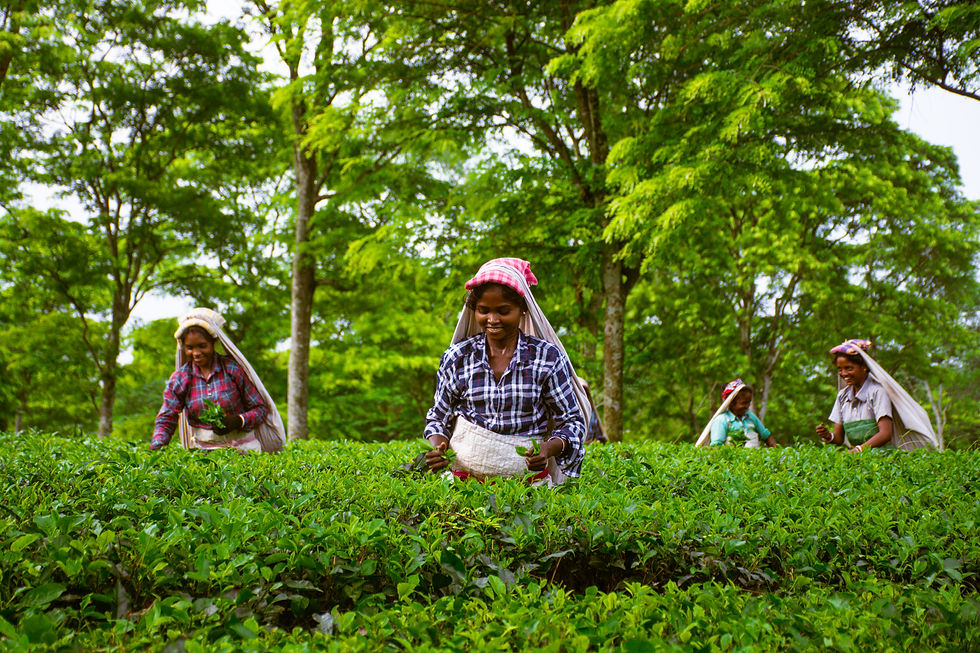

An Estate that is Lived in
Kamalpur is not just worked at, it is inhabited.
Multi-generational families have made their lives here, supported by housing, schooling, and healthcare close at hand. This is not incidental to how we harvest. The people who know this land best are the ones who have never left it, and that depth of connection is something no process can replicate.
The People behind Every Cup
Our workers are the foundation of our tea estate. Their skill, dedication, and care ensure that every harvest meets the highest standards. We are honored to share their voices and experiences, which reflect the spirit and heritage of our tea-growing community.


Chosen for consistency.
We supply our tea to leading tea buyers across India who value reliability at scale, a distinctive cup profile, and consistency across seasons.


A landscape shared with wildlife
Beyond the tea fields, Kamalpur is home to rich birdlife, native flora, and wildlife that move through the surrounding landscape. Over the years the estate has also been featured in the media for several notable wildlife encounters, reflecting its close connection with the natural landscape it inhabits.